Tuesday, March 6, 2018

Blue Magnetic Hand/ Blue Overtone Storm - Galactic Hawk Moon of Integrity, Day 27


Blue Magnetic Hand


Beneath the silver Eyelash
Of a Cosmic New Moon

Blue Hand
Passes o’er the Land

Manifesting in its Passing
Perfect Healing

 Accomplishment of
Knowledge

Complete Comprehension –
Peace and Understanding.


©Kleomichele Leeds
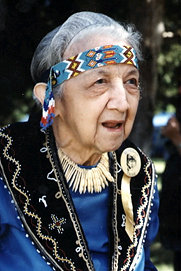


Gladys Tantaquidgeon


Gladys Iola Tantaquidgeon (June 15, 1899 – November 1, 2005) was a Mohegan medicine woman, anthropologist, author, tribal council member, and elder based in Connecticut.

As a young girl, she was selected by women elders for training in traditional pharmacology and culture. She studied anthropology at the University of Pennsylvania with Frank Speck. Beginning in 1934, Tantaquidgeon worked with the Bureau of Indian Affairs for more than a decade, including several years among western Native American tribes. Together with her father and brother, in 1931 she founded the Tantaquidgeon Indian Museum, the oldest to be owned and operated by Native Americans.

She published several books about Native American traditional medicine and healing with plants. For years she preserved vital records and correspondence of tribal members, which proved integral to their making the case for federal recognition, which the Mohegan received in 1994. That year, Tantaquidgeon was inducted into the Connecticut Women's Hall of Fame.

Biography

Gladys Tantaquidgeon, was the third of seven children born to Mohegan parents, John and Harriet Fielding Tantaquidgeon. They lived on Mohegan Hill in Quinnetucket (Uncasville, in New London County, Connecticut). She was a 10th-generation descendant of the Mohegan chief Uncas, who was prominent in the colonial era. The Mohegan were among tribes who spoke one of the many Algonquian languages.

In childhood, Gladys learned traditional practises, beliefs, and lore from nanus, respected women elders. By age five, the tribal nanus had chosen her to be schooled in the traditions of Mohegan culture. One of her mentors was the Mohegan traditionalist Fidelia Fielding (1827–1908). From Fielding, she learned the ways of the makiawisug[b] who guard the healing plants.

Another mentor was her maternal aunt, Nanu Emma Fielding Baker (1828-1916). In 1992 Baker was posthumously elected by the tribe as the Mohegan Tribal Medicine Woman and was inducted into the Connecticut Women's Hall of Fame for her work in education and preservation. Gladys started studying with her aunt in 1904, specializing in traditional herbal medicine. In her youth, Gladys had only occasional non-Indian education and never attended high school.

In 1919, at the age of 20, Tantaquidgeon attended the University of Pennsylvania to study anthropology. The scholar Frank Speck had met her as a child while he worked with her nanu Fidelia Fielding. When she was old enough, he invited her to study with him at Penn; he arranged work for her support, housing with foreign students, and classes and fieldwork to broaden her understanding of Native American cultures. Tantaquidgeon later did field work related to the Lenape and other eastern Algonquian tribes. She expanded her knowledge of traditional pharmacopoeia by researching herbal medicine practices among many related East Coast tribes.

From 1934 to 1947, at the time of the Indian Reorganization Act and the Indian New Deal under the administration of President Franklin D. Roosevelt, Tantaquidgeon started work with the US Bureau of Indian Affairs. She was hired in 1934 under the Wheeler-Howard Act to administer social service benefits for Indians. At first she was assigned to the Yankton Sioux Indian Reservation in South Dakota.

In 1938 she transferred to the Indian Arts and Crafts Board to serve as a "Native Arts Specialist".Working in the Dakotas, Montana and Wyoming, she helped indigenous artisans preserve traditional skills and arts. In addition, she helped them form cooperatives and other institutions for the sale and management of their arts. She developed ways for tribes to revive their cultural practices. According to the Mohegan Tribal Historian Melissa Fawcett, while working for the federal Indian Arts and Crafts Board, Tantaquidgeon also helped preserve customs that had been prohibited in the 19th century, such as the Ghost Dance and the Sun Dance. Part of Tantaquidgeon's job was to encourage the restoration of these and other previously prohibited traditional practice

In 1931, Tantaquidgeon worked with her brother Harry, a former chief, and father John to found the Tantaquidgeon Indian Museum. It is the oldest such museum to be owned and operated by Native Americans. After concluding her government service in 1947, Tantaquidgeon returned to Mohegan Hill, Uncasville. She worked full-time at the museum for the next 50 years, until 1998.

As a librarian in the Niantic Women’s Prison in the late 1940s, Tantaquidgeon had helped minority women. During the 1970's and 1980's, she also served on the Mohegan Tribal Council, encouraging the preservation and revival of tribal customs and language.

She published several books in her lifetime about traditional herbal medicine. Her best-known work, A Study of Delaware Indian Medicine Practices and Folk Beliefs (1942), was reprinted in 1972, 1995 and 2000 as Folk Medicine of the Delaware and Related Algonkian Indians. In 1992 she was elected as the Tribal Medicine Woman of the Mohegan.

Tantaquidgeon preserved numerous records and tribal correspondence in boxes under her bed. These proved critical as documentation to aid the tribe's case for federal recognition. As a people without a reservation, they had to prove community continuity. They gained federal recognition in 1994 as part of a settlement of their land claim, under a bill by Congress.

Dr. Gladys Tantaquidgeon was the great-aunt of Melissa Tantaquidgeon Zobel, an author and the current Mohegan Medicine Woman.

Legacy, awards and honors

As an "outstanding role model", Tantaquidgeon was awarded the 'Tiffany Jewel' by the University of Connecticut.
Connecticut Education Association's Friend of Education Award
For "consistent endeavor in the area of social justice", she received the National Organization for Women’s Harriet Tubman Award in 1996.
She received honorary doctorates from the University of Connecticut (Doctor of Humane Letters degree, 1987) and Yale University (1994).
In 1994, she was inducted into the Connecticut Women's Hall of Fame.
Her 100th birthday, June 15, 1999, was declared as 'Gladys Tantaquidgeon Day' by Gov. John G. Rowland of Connecticut; and was marked in the U.S. Congress by Hon. Sam Gejdenson*


MANIK


Kin 27: Blue Magnetic Hand


I unify in order to know
Attracting healing
I seal the store of accomplishment
With the magnetic tone of purpose
I am guided by my own power doubled.


Submission and humility open the door to the super-mental descent dissolving and transforming the present human into the superhuman.*


*Star Traveler's 13 Moon Almanac of Synchronicity, Galactic Research Institute, Law of Time Press, Ashland, Oregon, 2017-2018.


The Sacred Tzolk'in 


Manipura Chakra (Limi Plasma)


Monday, March 5, 2018

White Cosmic World-Bridger/ White Self-Existing Mirror - Galactic Hawk Moon of Integrity, Day 26


13 Cimi


White Cosmic World-Bridger


The Work of Love
Unties the (K)nots
Which smother us
And choke –

The Work of Love
Cuts the Dust
From past Mistakes -
Erases Pain prolonged

The Work of Love
Clears the Sphere
Of Shame and Blame
Allowing sweet Forgiveness

The Work of Love
Perfects the Soul
Exposing Shadow
To heal and render whole.


©Kleomichele Leeds


Margo Tamez


Margo Tamez (born 28 January 1962 in Austin, Texas, United States) is a Lipan Apache author of the Hada'didla Nde' (“Lightning Storm People”), Konitsaii Nde' (“Big Water People”). She is an enrolled citizen of the Lipan Apache Band of Texas.

A scholar, poet, and Indigenous rights defender, Tamez grew up in unceded Lipan Apache territory in South Texas, the Lower Rio Grande Valley and along the Texas-Mexico border.

Tamez's 2007 work, Raven Eye, is considered the first Apache-authored literary work which 'indigenized' the American poetry form known as the 'long poem', a form developed by Norman Dubie. In Raven Eye, Tamez drew from Athabaskan and Nahua creation stories, oral tradition, and Lipan Apache genocide narratives in combination with autobiography. Raven Eye connected the Lipan Apache oral narrative structure from the Lower Rio Grande valley and southern Texas to a literary aesthetic form that included pictorial writing and history of resistance. Her poetry is best known for stark, detailed examinations of gender violence, identity, non-recognition, genocide and spaces of abjection (walls, the camp, death march, exile). Her prose reflects the critical views of processes and on-going effects of fragmentation, historical erasure, and dispossession on Indigenous peoples, making crucial links between history and present forces (colonization, militarization) impacting Indigenous self-determination in regions bifurcated by settler nation borders where those who remained in traditional places were largely ignored by the state.

Selected bibliography

Poetry and criticism

Naked Wanting (University of Arizona Press, 2003).
Raven Eye (University of Arizona Press, 2007).
"Open Letter to Cameron County Commission," 2 Crit 110 (2009).
"My Mother in Her Being--Photograph ca. 1947," Callaloo, Vol. 32, No. 1, Winter 2009, pp. 185–187.
"Restoring Lipan Apache Women's Laws, Lands and Strength in El Calaboz Rancheria at the Texas-Mexico Border," Signs, Vol. 35, No. 3, 2010, pp. 558–569.
"Our Way of Life is Our Resistance": Indigenous Women and Anti-Imperialist Challenges to Militarization along the U.S.-Mexico Border," Works and Days, Invisible Battlegrounds: Feminist Resistance in the Global Age of War and Imperialism, Susan Comfort, Editor, 57/58: Vol. 20, 2011.
Anthologies
Dance the Guns to Silence: 100 Poems Inspired by Ken Saro-Wiwa
Sister Nations, Heid Erdrich and Laura Tohe (Editors), New Rivers Press.
Stories from Where We Live: The Gulf Coast, Sara St. Antoine (Editor), Milkweed Editions.
Southwestern Women: New Voices, Caitlin L. Gannon (Editor), Javelina Pr.*


CIMI


Kin 26: White Cosmic World-Bridger


I endure in order to equalize
Transcending opportunity
I seal the store of death
with the cosmic tone of presence
I am guided by the power of heart.


Stand up and go to the highest place - the place that everyone knows exists.*


*Star Traveler's 13 Moon Almanac of Synchronicity, Galactic Research Institute, Law of Time Press, Ashland, Oregon, 2017-2018.


 The Sacred Tzolk'in


Visshudha Chakra (Alpha Plasma)


Sunday, March 4, 2018

Red Crystal Serpent/ Red Electric Earth - Galactic Hawk Moon of Integrity, Day 25


12 Chicchan


Red Crystal Serpent


Universal Water pours
From cosmic Moons

Harmonics modify
 Fractal Frequencies

 Crystal Visions
Guarantee Survival

Galactic Ethers blaze
Hot Red and White

Instinct transforms
Into creative Flight.


©Kleomichele Leeds


Marjorie Tallchief


Marjorie Tallchief (born October 19, 1926) is a former ballerina of the Osage Nation. She is the younger sister of the late prima ballerina, Maria Tallchief, and was the first Native American to be named "première danseuse étoile " in the Paris Opera Ballet.

Early Life

Marjorie Louise Tall Chief was born October 19, 1926, in Denver, Colorado while her parents, Alexander Tall Chief and his wife, Ruth (née Porter), were on a family vacation with her older siblings, brother Gerald and sister Maria. She grew up in Fairfax, Oklahoma until 1933, when her family moved to Los Angeles so she and her sister could train in ballet dancing. She trained with Bronislava Nijinska and David Lichine.

Career

After completing her training in Los Angeles, Marjorie began performing for several dance companies. In the book, American Indian Ballerinas, Lili Cockerille Livingston wrote that Marjorie Tallchief had her professional debut with Lucia Chase and Richard Pleasant's Ballet Theatre as a first year soloist, in 1944. According to the Encyclopedia of Oklahoma History and Culture, these included: "... the American Ballet Russe de Monte Carlo (1946-47), the Grand Ballet du Marquis de Cuevas (1948-55), Ruth Page's Chicago Opera Ballet (guest artist, 1958-62), and the Harkness Ballet (prima ballerina, 1964-66). Her most acclaimed roles were performed in Night Shadow (1950), Annabel Lee (1951), Idylle (1954), Romeo and Juliet (1955), and Giselle (1957)."

She was the first Native American to be "première danseuse étoile" of the Paris Opera Ballet and performed with the Grand Ballet du Marquis de Cuevas. During her career she also performed for politicians such as U.S. Presidents John F. Kennedy and Lyndon B. Johnson, and foreign dignitaries such as Charles de Gaulle. Marjorie taught at Dallas Civic Ballet Academy, later known as the Dallas Ballet. After her retirement from the stage, she acted as a dance director for the Dallas Ballet, the Chicago Ballet School and the Harid Conservatory until 1993.

Accolades

In 1991, she was inducted into the Oklahoma Hall of Fame. In October 1997, she and her elder sister Maria, along with Moscelyne Larkin, Rosella Hightower, and Yvonne Chouteau, were named Oklahoma Treasures at the Governor's Arts Awards.

Personal life

She had two children with her husband, the late director and choreographer George Skibine, and currently lives in Boca Raton, Florida.*


CHICCHAN


Kin 25: Red Crystal Serpent


I dedicate in order to survive
Universalizing instinct
I seal the store of life fore
With the crystal tone of cooperation
I am guided by the power of navigation.


That which is hidden or non-manifest exists in a world beyond human perceptions which we know as the imaginal world.*


*Star Traveler's 13 Moon Almanac of Synchronicity, Galactic Research Institute, Law of Time Press, Ashland, Oregon, 2017-2018.


The Sacred Tzolk'in 


Svadhistana Chakra (Kali Plasma)


Saturday, March 3, 2018

Yellow Spectral Seed/ Yellow Lunar Warrior - Galactic Hawk Moon of Integrity, Day 24


11 Kan


Yellow Spectral Seed 

Consider
The endurance
Of a Seed –
Compact Promise
Concealed Precision 
Dormant Possibility

Within Acorn
A Forest entire –
An Empire of Trees
With Bounty enough
To feed the Nations

One conscious Mind
Fully nurtured and awake
Can move us
From Despair to Joy –
Blindness to clear Sight

Can lead us from Grief –
Out of Fear –
Guide us with Grace
To gaze upon the Tree of Life
In a Garden of Delight.


©Kleomichele Leeds


Maria Tallchief, Prima Ballerina.


Elizabeth Marie "Betty" Tall Chief (Osage family name: Ki He Kah Stah Tsa; January 24, 1925 – April 11, 2013) was an American ballerina. She was considered America's first major prima ballerina, and was the first Native American to hold the rank.

Almost from birth, Tall Chief was involved in dance, starting formal lessons at age three. When she was eight, her family relocated from her birth home of Fairfax, Oklahoma, to Los Angeles, California, to advance the careers of her and her younger sister, Marjorie. At age 17, she moved to New York City in search of a spot with a major ballet company, and, at the urging of her superiors, took the name Maria Tallchief. She spent the next five years with the Ballet Russe de Monte Carlo, where she met legendary choreographer George Balanchine. When Balanchine co-founded what would become the New York City Ballet in 1946, Tallchief became the company's first star.

The combination of Balanchine's difficult choreography and Tallchief's passionate dancing revolutionized the ballet. Her 1949 role in The Firebird catapulted Tallchief to the top of the ballet world, establishing her as a prima ballerina. Her role as the Sugarplum Fairy in The Nutcracker transformed the ballet from obscure to America's most popular. She traveled the world, becoming the first American to perform in Moscow's Bolshoi Theater. She made regular appearances on American TV before she retired in 1966. After retiring from dance, Tallchief was active in promoting ballet in Chicago. She served as director of ballet for the Lyric Opera of Chicago for most of the 1970's, and debuted the Chicago City Ballet in 1981.

Tallchief was honored by the people of Oklahoma with multiple statues and an honorific day. She was inducted in the National Women's Hall of Fame and received a National Medal of Arts. In 1996, Tallchief received a Kennedy Center Honor for lifetime achievements. Her life has been the subject of multiple documentaries and biographies.*


KAN


Kin 24: Yellow Spectral Seed


I dissolve in order to target
Releasing awareness
I seal the input of flowering
With the spectral tone of liberation
I am guided by my own power doubled.


To establish memory as continuing consciousness one must cultivate meditative awareness. The natural mind of innocence is the root of enlightened being.*


*Star Traveler's 13 Moon Almanac of Synchronicity, Galactic Research Institute, Law of Time Press, Ashland, Oregon, 2017-2018.


 The Sacred Tzolk'in


Ajna Chakra (Gamma Plasma)


Friday, March 2, 2018

Blue Planetary Night/ Blue Magnetic Eagle - Galactic Hawk Moon of Integrity, Day 23


10 Akbal

Blue Planetary Night


An Abundance 
Of Dreams and Visions
Dwell in Blue Planetary Nights

Up from the Depths
Rise Symbols and Themes
Redolent with Meaning

Treasure All –
For numinous are These
And Sacred –

Holding Energy enough
To render Whole
A lost or broken Soul.


©Kleomichele Leeds


Margaret Tafoya "Water Serpent" Pottery.


Maria Margarita "Margaret" Tafoya (Tewa name: Corn Blossom; August 13, 1904 – February 25, 2001) was the matriarch of Santa Clara Pueblo potters. Margaret learned the art of making pottery from her parents Sara Fina Guiterrez Tafoya (1863–1949) and Jose Geronimo Tafoya (1863–1955). Sara Fina was considered the leading potter of Santa Clara in her day, as the master of making exceptionally large, finely polished blackware. She also occasionally made redware, micaceous clay storage jars and other smaller utilitarian forms. Margaret’s father was primarily concerned with raising food for the family but he was also known to make pottery and helped Sara Fina with many aspects of her pottery production.

In 1924, Margaret married her husband Alcario Tafoya (1900–1995). Alcario and Margaret worked together making pottery just as her mother and father had done. Margaret and Sara Fina’s husbands both helped with the tasks of digging and preparing the clay and the firing of the pots. Alcario also helped Margaret with the creation and carving of designs on her pots. Like her mother, Margaret molded her pots using the traditional coiling method. "This method and many of the techniques used in the production of her pottery has been dated as being as more than 1200 years old, with the ancient "Anasazi" of the Colorado Plateau being the founding culture. A common misconception was the belief that black on black, burnished pueblo pottery had "died out," according to Larry Frank and Francis H. Harlow. "In reality, the nearby inhabitants of Santa Clara Pueblo were still producing the highly burnished, black on black pottery, since the 1600's, therefore lending to the revival of the San Ildefonso style of black on black "painted" pottery. The only difference between the two pueblo's styles is that in Santa Clara, pots are deeply carved and incised, whereas, in San Ildefonso, the pottery is generally not carved and painted with pigments to cause unpolished designs on a polished surface."

In the early 20th century, as Maria Martinez was developing the San Ildefonso style of traditional pottery, it was well known that she in fact learned various polishing (burnishing) techniques from Margaret Tafoya, as well as how to turn any color of clay black, by simply smothering the fire with manure.

Margaret continued her mother’s tradition of making exceptionally large pots, with finely polished surfaces and simple carved designs. Her “bear paw” motif and deeply carved pueblo symbols like the Avanyu (water serpent) and kiva steps around the shoulder of her jars have become signature trademarks of the Tafoya family pottery.

By the 1960's Margaret’s pottery had become famous. She received the Best of Show Award in 1978 and 1979 at the Santa Fe Indian Market. In 1984, the National Endowment for the Arts awarded her a National Heritage Fellowship in recognition of her accomplishments. She was also recognized and received an award as a Master Traditional Artist in 1985. In 1992 she received the Lifetime Achievement Award from the national Women's Caucus for Art.

Margaret and her husband Alcario raised thirteen children, and many grandchildren, as well as great grandchildren, many of whom are carrying on the Tafoya family tradition of pottery making. Those actively making pottery today include: Toni Roller, Jeff Roller, LuAnn Tafoya, Chris Youngblood, Nancy Youngblood, Nathan Youngblood, Darryl Whitegeese, Ryan Roller, Cliff Roller, Tyler Roller, Jordan Roller, James Ebelacker, Sarena Ebelacker, and Jamelyn Ebelacker.*


AKBAL


Kin 23: Blue Planetary Night

I perfect in order to dream
Producing intuition
I seal the input of abundance
With the planetary tone of manifestation
I am guided by the power of magic.


When the artist becomes conscious of what he/she is transmitting, then that artist becomes a medium of the highest orders.*


*Star Traveler's 13 Moon Almanac of Synchronicity, Galactic Research Institute, Law of Time Press, Ashland, Oregon, 2017-2018.


The Sacred Tzolk'in


Muladhara Chakra (Seli Plasma)


Thursday, March 1, 2018

White Solar Wind/ White Cosmic Wizard - Galactic Hawk Moon of Integrity, Day 22


9 Ik

White Solar Wind


Illusion
Hides Infinity
Mortality masks
Eternity

Solar Wind
Strips Lie from Truth
Reducing both
 To Bone

 When phantom Souls
Sip Tears of Love
Flesh and Sinew
Grow

Sacred Shapes
Emerge revealed
Blessed – transfigured
Unconcealed.


©Kleomichele Leeds              


Miami Tribal Warrior in Regalia.


Tacumwah (c. 1720 – c. 1790), alternate spelling "Taucumwah", aka Marie-Louise Pacanne Richerville (Richardville), was a businesswoman and prominent chieftess of the Miami tribe. She was the sister of Pacanne, a leading Miami chief, and the mother of Chief Jean Baptiste Richardville (or "Peshewa"). The name Tacumwah means "Parakeet" in the Miami language.

Tacumwah married Antoine Joseph Drouet de Richardville, the son of a French nobleman who was serving as a lieutenant in the French garrison at Fort St. Phillipe, later Fort Miamis. Richerville—who later Anglicized his name as Richardville, the form in which he passed the name to his son—later left the area and became a fur trader in Canada. Tacumwah had three other children. They were all baptised in 1773 by Father Pierre Gibault, but Tacumwah divorced Richerville a year later when he sided with Alexander and Francis Maisonville for control of the Long Portage, an 8-mile strip of land between the Maumee and Wabash Rivers that was controlled by her brother Pacanne. Richerville physically beat Tacumwah in the ensuing argument, and she took refuge with his business rival Charles Beaubien. Pacanne and Beaubien physically threatened Richerville and the Maisonville brothers, and the matter was taken to court at Fort Detroit on 18 September 1774.

Court Case

The case was centered around the marriage of Tacumwah and Richardville, the larger effort being to "maintain control of a large amount of capital in the form of slaves, cattle, corn and wampum, and of control of a pivotal portage that Tacumwah had inherited by virtue of her Miami lineage." For Tacumwah, the fact that she had been raised by a mother brought up in a matrilineal tradition which could be relevant to how Tacumwah carried herself. Pacanne alluded to this when he referred to his sister's possessions as belonging to her and not her husband since they had been inherited from her mother. This confirmed that Tacumwah's mother had gained valuable belongings in her own right, and her right to pass these onto her daughter was indisputable. It was decided that Pacanne would keep control of the portage, and Tacumwah would keep all her property.

Aftermath

Tacumwah married Beaubien, and they had one daughter, Josetta Beaubien Roubidoux. According to custom, Josetta's eldest son should have succeeded his uncle, Chief Richardville, as a chief of the Miami, but Josetta's descendants were repudiated by the tribe and stricken from the Miami roll in 1867.

Tacumwah was a political advisor to her son Peshewa, and sometimes spoke for him in the tribal council. She reportedly once put a knife into Peshewa's hand and told him to free a white captive whom other tribesmen were about to execute.

In her later years, Tacumwah ran a successful trading post. Her son Peshewa inherited her business holdings when she died.*


IK


Kin 22: White Solar Wind

I pulse in order to communicate
Realizing breath
I seal the input of spirit
With the solar tone of intention
I am guided by the power of endlessness
I am a galactic activation portal
Enter me.


Mind absorbs different data in the phenomenal realm through the senses, then structures and organizes it into images and language.*


*Star Traveler's 13 Moon Almanac of Synchronicity, Galactic Research Institute, Law of Time Press, Ashland, Oregon, 2017-2018.


The Sacred Tzolk'in


Sahasrara Chakra (Dali Plasma)