Our blog tracks Jose Arguelles' Dreamspell Calendar. "As chaos and confusion rise, galactic consciousness based on the Law of Time serves as planetary medicine, lifting us into the awareness that we exist within a higher, more expanded realm of existence than the world of third-dimensional form and appearance. Daily practice will elevate consciousness and increase experiences of synchronicity." (Arguelles)
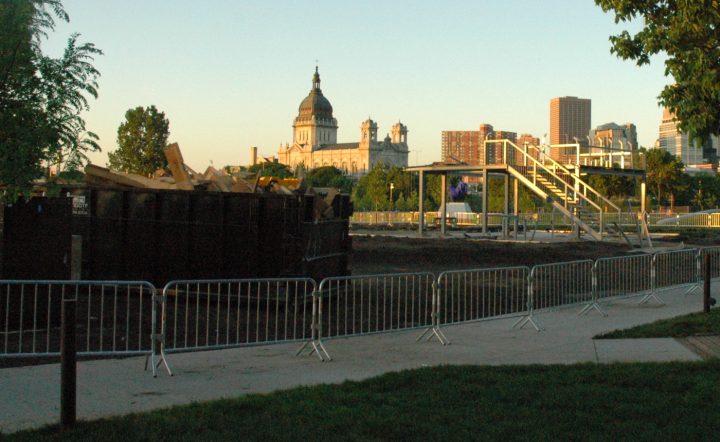
Sam Durant’s “Scaffold” (2012) mostly dismantled at its former site on the Minneapolis Sculpture Garden (photo by Sheila Regan/Hyperallergic)
In a few weeks, members of the Dakota nation will bury the wooden remains of “Scaffold,” a controversial sculpture by Sam Durant that was removed from the Minneapolis Sculpture Garden last June following protests from outraged Dakota groups. The decision to do so arrives after lengthy discussions between Dakota people over what to do with a public artwork that put on display a painful part of their history: a depiction of seven historical gallows used in state-sanctioned hangings, Durant’s sculpture referenced one device that was used to hang 38 Native men in Mankato, Minnesota at the end of the US-Dakota War of 1862. The Minneapolis Sculpture Garden, notably, also sits on former Dakota land.
The burial will occur at an undisclosed location around September 17 or 18, as the Star Tribune‘s Alicia Eler reported. An alternative fate would have been a ceremonial burning, which was initially part of an agreement Dakota leaders and elders had reached with members of the Walker Art Center and the Minneapolis Park and Recreation Board. The chief of the nation, Arvol Looking Horse, however, had reportedly not been consulted, and in later talks, insisted that the wood not be burned. The reasoning has less to do with concerns over historical connotations of censorship, which critics were quick to note, than with native customs.
“The wood has a spiritual nature that is inherent to itself in Lakota Dakota tradition,” Dakota elder Ronald P. Leith told the Star Tribune. “Of the four elements — fire, water, air, earth — you cannot use any of the elements in a disparaging fashion without putting yourself in a position of being disrespectful. To use fire to burn this wood that has a negative stigma attached to it — that is not allowed.”
Durant had given the Dakota people the copyright to the work, and members of the nation around Minnesota — as well as those exiled in other states — have since debated its fate. The steel and concrete structure of “Scaffold” have already been sent off to be recycled after Dakota construction workers dismantled it following a ceremony led by Dakota elders.
Leith also said that the burial site of its wooden pieces must be kept secret as native leaders are concerned that people will attempt to dig them up as crude souvenirs. Their actions would echo those that happened after the 1862 execution, he noted, when scavengers hunted for pieces of the dismantled gallows and gravediggers disturbed the buried prisoners.
A spokesperson for the Walker told Hyperallergic that “we continue to be in conversations with Dakota representative and to respect their decisions.”*
Courtesy Wind Over Fire Healing Arts Center/Facebook
A New Age “ghost dance” held in southwestern Minnesota has many indigenous people wondering just when the cultural appropriation will end.
New Age ‘Ghost Dance’ Held in Southwest Minnesota, Indigenous People Respond:
'Ghost Dance' organizers call it a ten moons dance, say it's not cultural appropriation
Indigenous social media was buzzing earlier this summer about a public Facebook invitation for an approaching Ghost Dance ceremony, hosted by what appeared to be non-Native American people in southwestern Minnesota. The event was shared from the Facebook page of the Wind Over Fire Healing Arts Center, which gave the event the name “Ghost Dance—a Healing Event for All.”
The invitation spread quickly throughout social media, with many Native people railing on Wind Over Fire’s cultural appropriation of the Ghost Dance ceremony sacred to Indigenous Peoples, and a ceremony that also carries a history of painful loss, suppression and tragedy.
The Wind Over Fire Healing Arts Center Facebook page also displayed photos of the “Ghost Dance” from the previous year, with men and women, appearing to be white, dressed in Native American–inspired clothing. This past year was their second annual ghost dance.
“Who gave you permission to conduct this ceremony?” wrote Elizabeth Roemer on the Facebook event page.
Within days of the social media outcries, the public event was deleted and removed from the Wind Over Fire page. Even after this, Native American Facebook users and their allies took to the Wind Over Fire Facebook page, leaving scathing reviews and remarks.
“Your cultural appropriation needs to stop,” Iktomi Zizi wrote. “You’re going to get people hurt playing around with ceremonies you know nothing about. Going to a ceremony a few times does not give anybody the right to perform or even act like they know about them.”
The widespread social media response made it very clear: Indigenous people were not happy with the event, and they were demanding answers from Wind Over Fire.
Mary Laven, director and founder of the Wind Over Fire Healing Arts Center, insisted that the ghost dance event is not what people think.
“[The invitation] was posted on my page,” said Laven, who is described on the Wind Over Fire website as an intuitive counselor, medium, psychic and medical intuitive. “But the event was sent out by mistake.”
Laven, a self-described Italian originally from New York, sponsors the dance, and says that everything is paid for by her but that no one is charged a fee to participate. She defended their ghost dance, unequivocally.
“I’m very curious as to why the Native people feel like their ceremonies can be taken from them,” Laven said in an interview with ICMN. “The Lakota think they’re the only ones who do the ghost dance, when European cultures do them, Chinese cultures do them. They do all kinds of ceremonies around their descendants.”
Laven also said the event was mistakenly called the ghost dance, that it’s really the ten moons dance. However, the event has been called a ghost dance before—in the summer of 2016, and before the social media backlash, the Wind Over Fire page sponsored an event also called a “Ghost Dance.” Laven now says that the ghost dance is universal.
“When you go back before [the ghost dance], the Jesuits termed it as a friendship dance, and before that, there was a ten moons dance,” said Laven. “So really, in truth, that’s what it is, the ten moons dance. But I called it what I knew [the ghost dance], because that is what was presented to me.”
Laven said the “ghost dance” the year before and the latest “ten moons dance” was inspired by a dream she had, calling her to host the ceremony.
The photos posted on the Wind Over Fire Ghost Dance event page also identified Leon Carney, resident of Chandler, Minnesota, as the “medicine man” of the ghost dance, seen wearing eagle feathers and holding a staff. Carney is not a member of any federally recognized tribe, but says that he has Native American ancestry, and can trace his indigenous roots back to the Wampanoag.
“I don’t even know if there are any [Wampanoag] members left anymore,” said Carney. “They were pretty well decimated by the English during the King Phillip wars.”
Despite Carney’s claims of decimated Wampanoag, there is in fact a Mashpee Wampanoag tribe of Massachusettes today. In light of his questionable identity, indigenous critics accused Carney of pretending to be a medicine man, playing with sacred ceremonies. Carney defended himself, saying, “Some people call me a medicine man, but I don’t know what the heck that is. I’m a certified body work therapist.”
Leon Carney also said he has been around Native American ceremonies for some time, specifically naming the AIM sundance at Pipestone, Minnesota, as an annual gathering he regularly attends.
“Where the altar is today at Pipestone, I was the one who actually dug and built the (sundance) arbor,” Carney told ICMN. “The sundance chief there is a good friend of mine, and so I understand all about the culture police.”
What’s more for Carney is that in addition to his participation in Native American ceremonies, he is also vice president of the nonprofit organization Keepers of the Sacred Tradition of Pipemaking. And in 2016, Carney hosted a ghost dance on his land, which was in fact, referred to as a ghost dance back then (according to a Facebook event page from 2016). The new version of the dance was held on his land, once again, just this summer.
“Mary [Laven] started this dance,” said Carney. “She wanted to do it, and she asked me, and I suggested that we do this as ten moons, and so this is the first year we did [the dance] as the ten moons dance. It is a ghost dance of a sort, but it’s not like the Paiute vision that was brought to the Lakota.”
After receiving a number of calls from outraged Native Americans, both Laven and Carney prepared for the possibility of protesters arriving to this year’s dance. Despite their worries, they say that the ten moons dance went on without any disruption.
“It would be great if everyone just joined together,” said Laven, discontented by the scrutiny of their ceremony and the charges of cultural appropriation. “We have enough crap. I was at Standing Rock, and I hear the Native Americans, and I had heard them.”
Still, many Native Americans are not satisfied with Laven’s or Carney’s explanations of what appears to be blatant cultural appropriation. As Native American communities continue to suffer the deep-rooted and traumatic residual effects of colonization, it does, in fact, strike a quick nerve among Native American communities to see members of the dominant society “playing Indian,” taking ceremonies, or even being inspired by indigenous ceremonies. For the masses of indigenous people who are fed up with centuries of oppression and cultural appropriation, it is more than likely never going to be “okay” for outsiders to continue to take and take, exploiting the very cultures that Indigenous Peoples are still fighting to regain.
Sam Wounded Knee, an enrolled member of the Crow Creek Dakota Nation, spoke to ICMN about his strong disagreement with the ceremonies held on Carney’s land.
“They don’t know what they’re doing, and they weren’t raised that way,” Wounded Knee told ICMN. “It’s disrespectful to not only Dakotas, and having it on our land, but also disrespectful to the Lakotas who were given that dance from Wovoka, who was Paiute.”
“They are obviously lost,” Wounded Knee said. “For them to think that they have a right to do things just because they threw us a couple of dollars [at Standing Rock], thinking they paid us off, it’s totally disrespectful.”*
Courtesy: Confederated Tribes of the Colville Seal.
10 Things You Should Know about the Confederated Tribes of the Colville Reservation:
14 tribes, or bands, occupy the Confederated Tribes of the Colville Reservation
The ancestors of the Confederated Tribes of the Colville Reservation were nomadic until April of 1872, when President Grant set aside several million acres in Washington state and assigned a number of tribes to the reservation. Just three months later, that area was reduced to about 2.8 million acres.
Today 14 tribes, or bands, occupy the reservation, which is divided into four districts for administrative purposes. The acreage measures 1.4 million acres located in north central Washington and over 5,000 people live here, both tribal and non-tribal. The council oversees a multi-million administration from its headquarters in Nespelem. Dr. Michael Marchand is the tribal chairman.
The Colville Confederated Tribes are rich in Native American iconic history. In 1885 Chief Moses invited Chief Joseph’s band of Nez Perce to come and live on the reservation. Chief Joseph walked on in 1904 and is buried near Nespelem. In 1892 the northern portion was ceded to the U.S. and rights were reserved to hunt and fish in that area for time immemorial, then in 1900 homesteading was allowed on the southern portion.
Salmon was always a big part of life for most bands, but that changed drastically when Grand Coulee Dam was completed in 1942 and the Chief Joseph Dam a few years later. Recent actions by the Colville Confederated Tribes are attempting to revive salmon populations.
The Colville Confederated Tribes are still making their mark in the world. One widely known event is the annual suicide race held during the Omak Stampede. During the dangerous race, riders on horseback race down a nearly vertical slope into the river below, then swim their horses across for the final dash to the finish line. 2017 marked the 84th year of the Stampede and Suicide Race.
Meghan Francis, Public Affairs Officer, described 10 important facts about the Colville Confederated Tribes for others to know about the Native people on the Colville Confederated Reservation.
12 Bands
“We have 12 bands, sometimes also referred to as tribes, which make up the Colville Reservation. These include the Arrow Lakes (Sinixt), Chelan, Colville, Entiat, Nespelem, Okanogan, Methow, Moses-Columbia, Joseph Band of Nez Perce, Palus, San Poll, and Wenatchi.”
Ancestral Origins
“We have a traditional maps that show original ancestral lands were from near Revelstoke in British Columbia south to Oregon. It also stretches from the Cascades in Washington over to the Columbia River.”
Lucy F. Covington Government Center
“The Lucy F. Covington Government Center building was financed through insurance claims when another building burned down including U-Market Tax Credit. It was recently dedicated on July 6th. A plaque sits outside summarizing Lucy Covington’s life.” Lucy was from this reservation and fought against the government and the Termination Bill of the 1950s, becoming a national leader in civil rights and the protection of tribal lands, and was described by others as ‘extraordinary.’”
Hunting on Traditional Homelands
“We hunt on traditional homeland areas. One is the north half that was seized for a dollar an acre. We got $1.4 million for that. We maintain our hunting rights there and are now working on maintaining those rights in Canada for our Arrow Lakes, or Sinixt Band from Canada.” A final decision should be rendered soon after suits and countersuits have been filed with different outcomes.
12 Tribes Resort and Casino
The resort and casino was built in 2015 along Highway 97 in Omak, Washington and sits an hour from Canada. It provides fine-dining in the restaurant with entertainment. It’s referred to as a ‘cosmopolitan’ hotel with 68 guest rooms and 56,000 square feet of casino space for slots and table games.
Francis added that the tribe has two other casinos and is allowed to have up to six.
Chief Joseph Hatchery
“The hatchery was a $51 million dollar project,” Francis pointed out. The hatchery opened in June, 2013 and was funded by Bonneville Power Administration. It has a 14,000 square foot hatchery building for incubating salmon eggs and holding fry, plus lab, shop and office space and outside raceways and rearing ponds. The first return of salmon to the hatchery was in May of 2016 and was held in conjunction with the traditional, ‘First Salmon Ceremony.’
Kettle Falls
“Kettle Falls was the hub of this area, the richest land because of the salmon runs. Tribes came to trade from the other side of the Cascades, north, south, and east. They would trade for salmon and we would trade for buffalo, shells, and different things. The falls are under water now because of Grand Coulee Dam.”
Icicle River
“That’s in traditional Wenatchi territory. Our Wenatchi Band reserved rights to fish in the river and only Wenatchi Band members can fish there plus Yakama Tribal members.” Other people can fish the Icicle River with state licenses during open season.
Superfund Site Tech Cominco
“We’ve been in litigation for over 20 years. The company in Canada has been pumping slag into the river and we’re working on having them clean it up.” This has been going on since the late 1800s and hundreds of thousands of tons of hazardous substances have since been deposited into the river and down to Lake Roosevelt on the reservation. The final decision and amount are yet to be determined.
Hemp
“We are the first and only tribe in the nation to grow hemp legally. Our plants are now 40-days-old, brand new, in this research pilot project.
We maintain permits from the Washington Department of Agriculture and the Farm Bill of 2014 and it’s legal through state and federal governments.
It came from the Czech Republic because we can’t grow hemp from the U.S. or Canada, it must be imported.” Meghan continued, “Hemp and marijuana are completely different. You can’t get high smoking hemp. The stalks are used for fiber and the seeds for oil. We have 60 acres and plan to grow more. Out plot is 100% organic with no fill, no pesticides and the fertilizer is organic as well.”*
Noogenesis is birth of the noosphere through a mental [noo]genesis, a mind "rebirth" while simultaneously embodying the descent of a "Sirian" personality.*
*Star Traveler's 13 Moon Almanac of Synchronicity, Galactic Research Institute, Law of Time Press, Ashland, Oregon, 2017-2018.
Every great person, regardless of culture, religion, tribe, or ethnicity, follows certain words of wisdom.
These words of wisdom transcend the differences between people. This code of living shapes one’s character. It molds each culture to be unique and unrepeatable.
Probably one of the most spiritually advanced and character building code is The Native American Code of Ethics which was originally published in the Inter-Tribal Times in October of 1994.
It is a Code of Ethics that teaches everyone, American or not, how to live the best life.
It is fascinating to note that most of its teachings are reflected in other beliefs and faith too.
The Native American Code of Ethics:
1. Rise with the sun to pray. Pray alone. Pray often. The Great Spirit will listen, if you only speak.
2. Be tolerant of those who are lost on their path. Ignorance, conceit, anger, jealousy and greed stem from a lost soul. Pray that they will find guidance.
3. Search for yourself, by yourself. Do not allow others to make your path for you. It is your road, and yours alone. Others may walk it with you, but no one can walk it for you.
4. Treat the guests in your home with much consideration. Serve them the best food, give them the best bed and treat them with respect and honor.
5. Do not take what is not yours whether from a person, a community, the wilderness or from a culture. It was not earned nor given. It is not yours.
6. Respect all things that are placed upon this earth – whether it be people or plant.
7. Honor other people’s thoughts, wishes and words. Never interrupt another or mock or rudely mimic them. Allow each person the right to personal expression.
8. Never speak of others in a bad way. The negative energy that you put out into the universe will multiply when it returns to you.
9. All persons make mistakes. And all mistakes can be forgiven.
10. Bad thoughts cause illness of the mind, body and spirit. Practice optimism.
11. Nature is not FOR us, it is a PART of us. Animals, plants and other living creatures are all part of your worldly family.
12. Children are the seeds of our future. Plant love in their hearts and water them with wisdom and life’s lessons. When they are grown, give them space to grow.
13. Avoid hurting the hearts of others. The poison of your pain will return to you.
14. Be truthful at all times. Honesty is the test of one’s will within this universe.
15. Keep yourself balanced. Your Mental self, Spiritual self, Emotional self, and Physical self need to be strong, pure and healthy. Work out the body to strengthen the mind. Grow rich in spirit to cure emotional ails.
16. Make conscious decisions as to who you will be and how you will react. Be responsible for your own actions.
17. Respect the privacy and personal space of others. Do not touch the personal property of others – especially sacred and religious objects. This is forbidden.
18. Be true to yourself first. You cannot nurture and help others if you cannot nurture and help yourself first.
19. Respect others religious beliefs. Do not force your belief on others.
20. Share your good fortune with others. Participate in charity.
We may differ in our faith, religion, and culture, yet we all live together on the same boat. We are only custodians and not owners of The Earth, not its conquerors nor its destroyers.*
Most art communicates subliminally; the more pure and attuned the art form and artist, the subliminal communication there will be in the form of artistic expression.*
*Star Traveler's 13 Moon Almanac of Synchronicity, Galactic Research Institute, Law of Time Press, Ashland, Oregon, 2017-2018.
“Our warriors cry, it shows they have compassion and courage to share and be leaders within the community,” said Maria Yellow Horse Brave Heart, a research associate professor at the University of New Mexico and director of Native American and disparities research, Center for Rural and Community Behavioral Health, at the National Indian Health Board-hosted 2017 American Indian and Alaska Native National Behavioral Health Conference.
NIHB Tackles Mental Health Issues:
Behavioral and mental health among topics discussed at National Indian Health Board-hosted conference
When it comes to her job, Clara Bushyhead does not pull any punches. The coordinator for the Cheyenne and Arapaho Tribes’ Tradition not Addiction program, Bushyhead acknowledges that in order to address some of the problems facing her tribes’ youth, like substance abuse and mental health, she sometimes has to cast a wider net.
“You have to go after the whole community,” she said. “You can’t just target the kids. Where are those kids getting alcohol? The number one response they gave us was ‘at home.’ Sometimes you have to be real with folks.”
Bushyhead was among the presenters who converged on the Hard Rock Hotel and Casino in Catoosa, Oklahoma in mid-August for a behavioral health summit. Hosted by the National Indian Health Board, the three-day affair gave attendees a chance to review and dissect some of the more successful initiatives underway in Indian country to address substance abuse rates, suicide prevention, and workforce development. Although there is little concrete data on depression rates in Indian country, what information is available implies a higher frequency of mental health issues among American Indian and Alaska Natives than their non-Native peers, especially among youth.
Higher rates of poverty, substance abuse and exposure to trauma—historical or otherwise—are among the multiple risk factors for mental illness seen more commonly in indigenous communities compared to society as a whole.
That data bears out the nine counties within the Cheyenne and Arapaho Tribes’ jurisdictional area. Prior to its launch, Cheyenne and Arapaho youth were nearly twice as likely to be arrested for an alcohol-related offense than a non-Native teen in three of the nine counties.
Despite initial hesitation from students, parents and school administrators, the SAMHSA-funded program has become more popular, thanks to a steady stream of activities, including beading classes, a Color Run and a community buffalo butchering session.
Since the program’s implementation in 2014, the rates of alcohol, tobacco and marijuana use have dropped among Cheyenne and Arapaho youth. The alcohol use rate alone has decreased almost 20 percent in less than three years from 45.3 percent in 2014 to 27.1 percent in 2016, a decline Bushyhead partially credits to the increased access to cultural activities.
“We are the ones who know our people,” Bushyhead said. “We shouldn’t wait on someone else to step up.”
Other presenters and attendees expressed a similar sentiment with respect to preventative mental health care.
“What good are we doing trying to help someone with diabetes if we don’t know where they are mentally?” Johnna James said.
A citizen of the Chickasaw Nation, James is the tribal liaison for the Oklahoma Department of Mental Health and Substance Abuse. Along with trying to coordinate policy decisions between the state and Oklahoma’s 38 federally recognized tribes via consultation, part of James’ position is to try to minimize the access to care disparities that exist within the state, as well as the impact that it can have on physical health.
That also sometimes means explaining why some practices and questions that routinely show up in mental health screenings are culturally inappropriate when working with indigenous clients.
“One of the mental health questionnaires we received in our office had this question early on: ‘Do you think the American government is out to get you?’” James said, drawing chuckles and head nods from summit attendees.
Awkward questions aside, further compounding the problem for many in Indian country is a provider shortage of mental health professionals.
According to the National Rural Health Association, among rural counties nationwide with a population of 20,000 or less, 75 percent do not have at least one practicing psychiatrist.
Among the estimated 605,000 Native Americans and Alaska Natives eligible to utilize one of Indian Health Services’ 41 urban health centers nationwide, only one in five reported being able to access those programs in 2000.
“We have to know what we’re working with,” James said. “There’s strength in your DNA.”*
NJ Superior Court Rules Nanticoke Lenni-Lenape are Sovereign Tribe.
NJ Superior Court Rules Nanticoke Lenni-Lenape are Sovereign Tribe:
Judge rules Nanticoke Lenni-Lenape’s civil rights violation lawsuit against the state of New Jersey for denying its status can proceed
In the latest round of Nanticoke Lenni-Lenape Tribal Nation vs New Jersey, the Superior Court of New Jersey Appellate Division reversed a Superior Court of New Jersey Law Division decision to dismiss the tribe’s case, thereby giving the 3,000-member
Tribal Nation a green light to proceed in its civil rights lawsuit against New Jersey’s Attorney General John Hoffman, who told the federal government that the tribe was not considered a “recognized” tribal nation.
The Appellate Court also ruled and publicly affirmed that the Nanticoke Lenni-Lenape Tribal Nation are “a constitutionally organized, self-governing, inherently sovereign American Indian tribe.”
How did it get here?
The Nanticoke Lenni-Lenape Tribal Nation, Powhatan Renape, and Ramapough Lenape have been recognized by the state of New Jersey for 35 or more years. The Nanticoke-Lenape, whose 3,000 citizens are economically distressed, relied on basic federal benefits tied to its status, including grants for diabetes care and education, and the ability to label their crafts as “Indian made.”
This changed for the worst in 2012, thanks to a two-sentence email sent by a staffer at the New Jersey Commission on American Indian Affairs to the federal government’s General Accounting Office in 2011. The email incorrectly said New Jersey had no recognized tribes. The situation was further inflamed by then-acting AG Hoffman, who told the federal government that the tribe was not considered a “recognized” tribal nation.
Former AG Hoffman is named as a co-defendant in the lawsuit. This resulted in the federal government considering all three New Jersey tribes to just be “social groupings” without formal state recognition.
In July 2015, the tribe filed a five-count civil rights complaint alleging that the New Jersey Attorney General “violated its civil rights under the New Jersey Constitution and breached duties imposed under the common law”. The tribe had also alleged that the AG’s actions “have and will deprive it of benefits under various federal statutes and programs.”
“This is not just about the tribe’s ability to economically sustain itself, it’s about their dignity and it’s about — after 200 years of being treated terribly by the colonies and then by the state – there was a period beginning in the 80s where the relationship turned,” Gregory Werkheiser, a civil rights attorney with Cultural Heritage Partners representing the tribe, explained to NJ.com.
“We are in the midst of an incredible national conversation about race in this country and, by and large, it’s a mature conversation. That is not the case today in New Jersey, where this administration is simply closing its eyes and pretending whole swaths of people do not exist.”
The lawsuit further alleged that the reason the Nanticoke-Lenape were now not being recognized is due to a “racial-stereotype-driven and irrational fear that any American Indian Tribe, if recognized as such, will seek to conduct gaming in competition with New Jersey’s politically powerful non-Indian gaming interests.”
The Federal court ruled in the tribe’s favor in October 2016. The Superior Court of New Jersey Law Division, on the other hand, approved the New Jersey AG’s request to dismiss the tribe’s complaint. The Superior Court of New Jersey Appellate Division reversed the dismissal last month.
With this reversal the tribe is now actively pursuing active cases in both the federal and New Jersey courts. The outcome was and still is very important because federal laws like the Indian Arts and Crafts Act of 1990 contain provisions that apply to state-recognized tribes and their members.
The denials about its status have left the tribe with a great deal of uncertainty and “devastating economic and social consequences,” according to the lawsuit.
In a 2015 discussion regarding “real“ vs. “fake” tribes, Dr. Nicky Michael, councilwoman of the federally recognized Lenape tribe The Delaware Tribe of Indians of Oklahoma told the Daily Beast, “The Nanticoke [in New Jersey] do have Native blood and are real.”
Ironically, as the Nanticoke-Lenape carried on with their struggle with the State of New Jersey, “the Nanticoke Indian Tribe and its sister tribe the Lenni-Lenape [of Delaware] had something special to honor during the 39th annual Nanticoke Pow Wow [in September 2016]—formal [State] recognition of their status as Tribes.”
For more information on the Nanticoke-Lenape Tribal Nation, visit their tribal government website. You can download the free e-Book We Are Still Here… The Tribal Saga of New Jersey’s Nanticoke and Lenape Indians or “The Incomplete Loom: Exploring Checkered Past & Present of American Indian Sovereignty” Rutgers Law Review Legal Note. You can also visit the online Nanticoke and Lenape Confederation Learning Center and Museum.*